

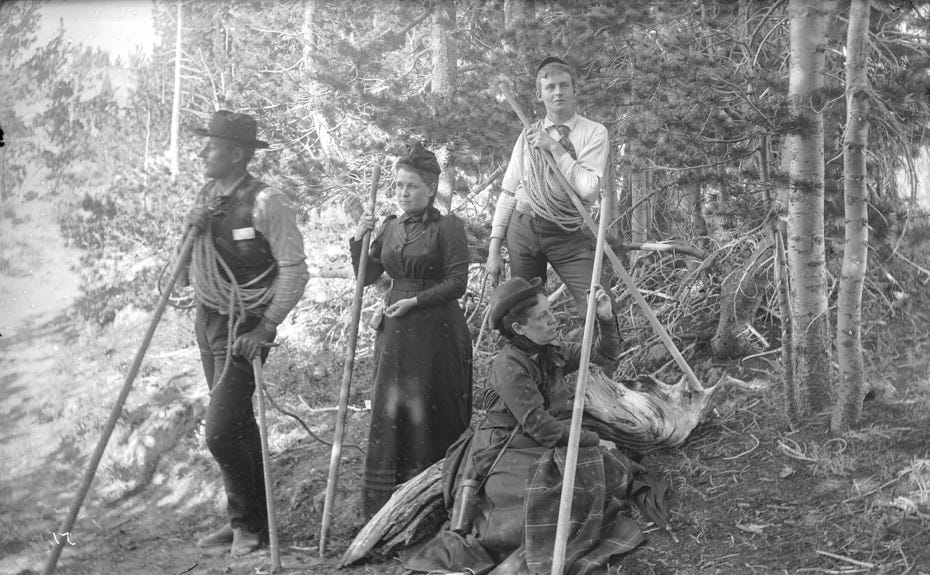
Have you ever come into new information about your ancestors that has, in a blink of a moment, completely reshaped how you see the past, present, and future?
In a previous article, I shared a glimpse into my own experience of this—the upturning of a stone that hid beneath it a wild story of two brothers, William and Harold “Doug” Langille, who just so happen to be my cousins. In 1896, those relatives guided Gifford Pinchot, the man who would become the first Chief of the U.S. Forest Service, around their “backyard.” That backyard was Oregon’s Mount Hood and its surrounding forests and river valleys.
I first came into this information in the spring of 2026 and have been digging deeper and deeper into what is readily available online. I’ve been retracing their family’s footsteps from Nova Scotia to California and eventually to Oregon, with a few other stops in-between due to the railroad systems of the mid-1800s. I am trying to understand how they got there, but also how they would become two influential people in developing and shaping the U.S. Forest Service of the 1900s, which is vastly different from the present-day version. Furthermore, their work did not remain in Oregon but would expand as far north as Alaska and as far south as South America.

My questions are too many for one article, and I am envisioning a more comprehensive research project. But for the sake of today and what keeps me awake at present—I want to understand why our present-day administration, the very government that in the late 1800s and early 1900s saw clearly the value and importance of protecting and preserving our forests, is now so eager to further deplete them or subject them to irreversible damage?
While I string those words together, I know the answer, yet I still sit here frustrated, confused, and angry. In part because it was no small feat in 1896 to guide someone around a still-active volcano with active glaciers and an unpredictable landscape. My cousin William did so so expertly that he was recruited to go into the wilds of Alaska to help map out and define the protective lines of what we know to be the Tongass National Forest and Chugach National Forest. He’d later be labeled a ‘Father of Forestry’ as he risked life and limb to stand up not just to the natural wilds of the land with primitive mountaineering and forestry tools, but to the industrial greed of the time—hungry for timber, hungry for copper, and captivated by the gold rush.
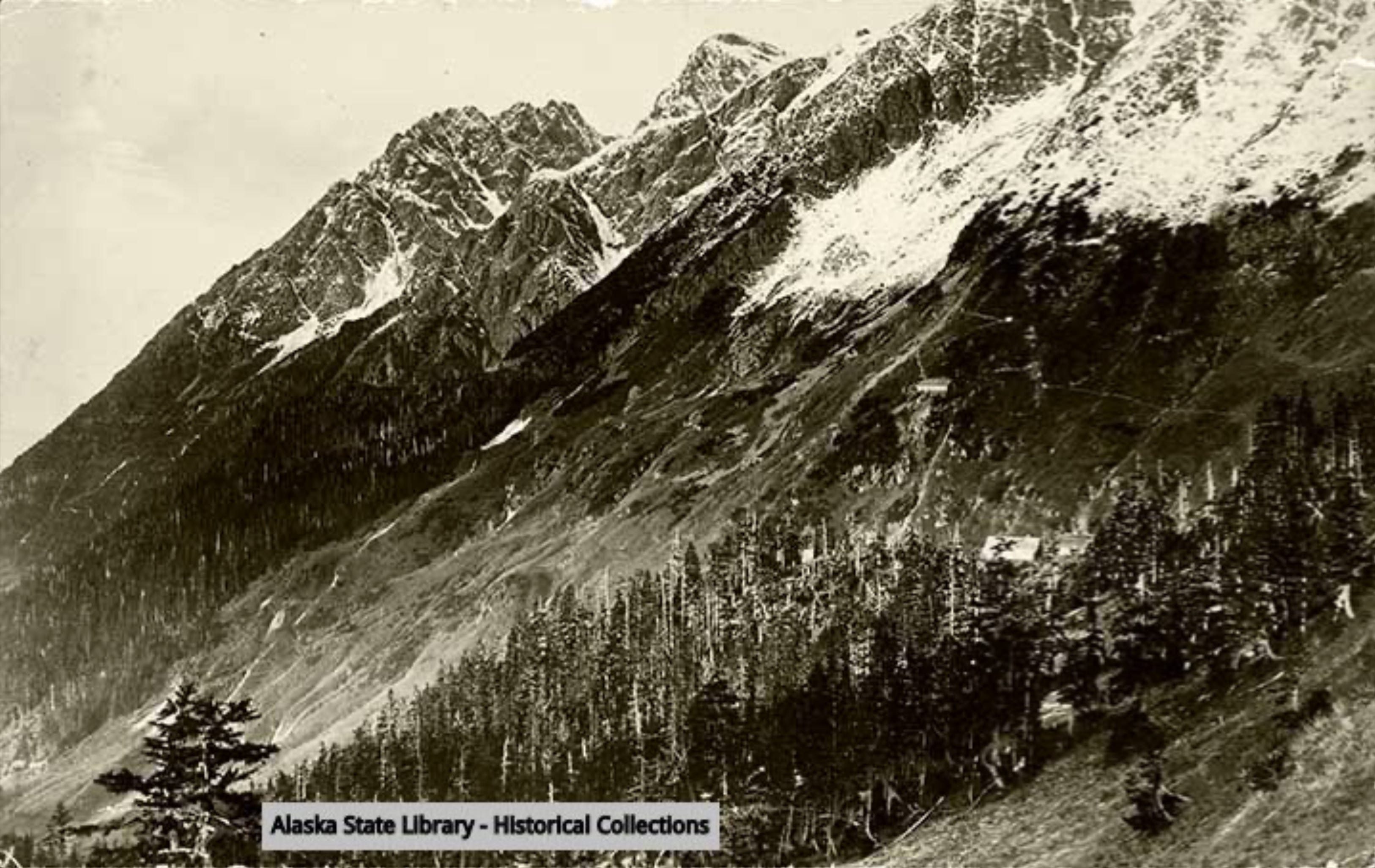
The history here is as deep as some of the mines of that time, but what is irking me the most with the timing of my own discovery is how it has come to a head with the present day. Specifically, the USDA’s filed proposal to fully repeal the 2001 Roadless Area Conservation Rule—a rule whose core purpose has been, and remains, to protect pristine backcountry ecosystems, wildlife habitats, and clean water sources from industrial use. If my relatives were alive today, I imagine them red with fury. I’ve read my cousin William had quite the personality and was both respected and feared for his devotion to the job and commitment to the conservation of the land. Of course, it was also noted that this was perhaps at times to a detriment, and I take that as a reminder of how to respond to the woes of today.
For me personally, it feels like my ancestors’ legacy is being bulldozed over, much like the land that will be forever altered if they are successful in their dismantlement of this publicly favored rule.
I do not feel like a casual observer as this administration attempts to repeal the 2001 Roadless Rule; instead, I feel a deep responsibility to use my voice and be an extension of their legacy.
This sensation feels akin to running a relay race, where you have been handed the baton and you have exactly two jobs: don’t drop it, and give it your all for the team.
With the baton firmly in my hands and fully in the race, I am trying to learn more, engage as much as possible, and find ways to not give up—even when it feels impossible to do anything at all to stop this from happening.
I want to leave you with a seed of curiosity and a path for how you can help today. Because since my cousins left behind their own research, many others have studied and added positively to the pool of solutions that already exist. The waterlines have been defined, and the data completely dismantles the myths that roads and human access will somehow better serve the places that would be most impacted by the rollback of this rule.
Please explore some of the peer-reviewed studies and uncover for yourself why leaving 44.7 million acres of pristine forest roadless is not neglect, but an active, proven way to mitigate the worries of today. The Roadless Rule has been a successful solution that, like anything, may need refining, but it should not be removed.
Here is my 5-minute action plan, because it is never too late to engage and it often only requires a few minutes of your time:
The caveat is that the clock is ticking and there is a strict deadline. We have until ⏰ midnight Eastern Time on September 21, 2026 October 6,2026 1, to flood the public record. The government is legally required to read and log our objections. (There are strong opinions on whether or not they will abide by the rule of law, but we have to try regardless of those doubts.)
You can submit an official public comment by heading directly to the Federal Register via Regulations.gov (Docket FS-2025-0001) to share your formal objection to rescinding the rule.
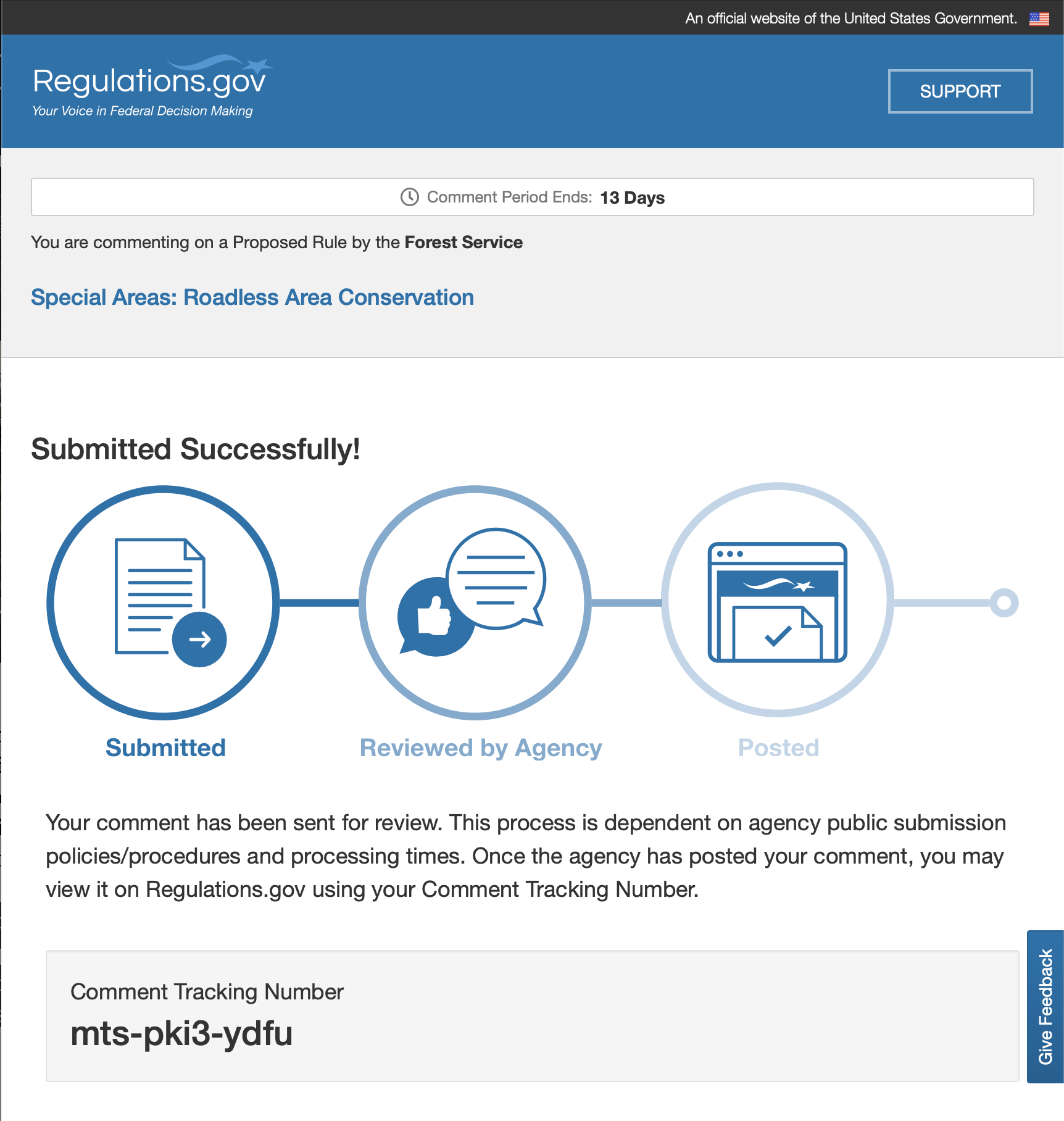
If this feels intimidating to you, you can copy and paste these words and adjust them to fit your voice:
“I oppose the proposal to rescind the 2001 Roadless Area Conservation Rule because our remaining forest ecosystems are our best natural defense against climate change and preservation of clean drinking water. I support forest management that prioritizes ecosystem integrity over industrial road expansion.”
Next steps that cost nothing:
Organizations like the Sierra Club, Earthjustice and National Parks Conservation Association (NPCA) are leading the legal charge. Please visit their action pages, sign their petitions, and share this article with friends and family who care about our public lands. Because one thing they did not have in the early 1900s, that we do have, the means to quickly voice our concerns and share it with the world.
Additional Reading:
Stephen R. Mark, “William A. Langille (1868-1956),” The Oregon Encyclopedia.
Frederick V. Coville, Forest Growth and Sheep Grazing in the Cascade Mountains of Oregon, U.S. Department of Agriculture, Division of Botany, Bulletin No. 15 (1898).
Gregory H. Aplet et al., “Wildfire Ignitions in Relation to Road Proximity Across the U.S. National Forest System,” Fire Ecology (2026); see also The Wilderness Society Research Brief. For watershed protections, see PLOS Water (July 2026), documenting that inventoried roadless areas protect drinking water sources for approximately 25 million Americans.
The Forest Service, Agriculture (USDA) on September 11, 2026 published an extension of the public commenting period.
Hi Jenn and thanks for sharing more about your ancestors and your journey of discovery. I also really appreciate how easy you made it to post a comment on the .gov website. Would you consider sharing this info on the Trailbound discord servers so others can take these action steps, too? Thanks for all you are doing to be a great steward of the earth and Trailbound Sketches!
UPDATE: On September 11, 2026 they extended the public comment period to October 6, 2026. The full release here: https://www.federalregister.gov/documents/2026/09/11/2026-18648/special-areas-roadless-area-conservation